ZSOUND Guide: What is a Professional Line Array System?
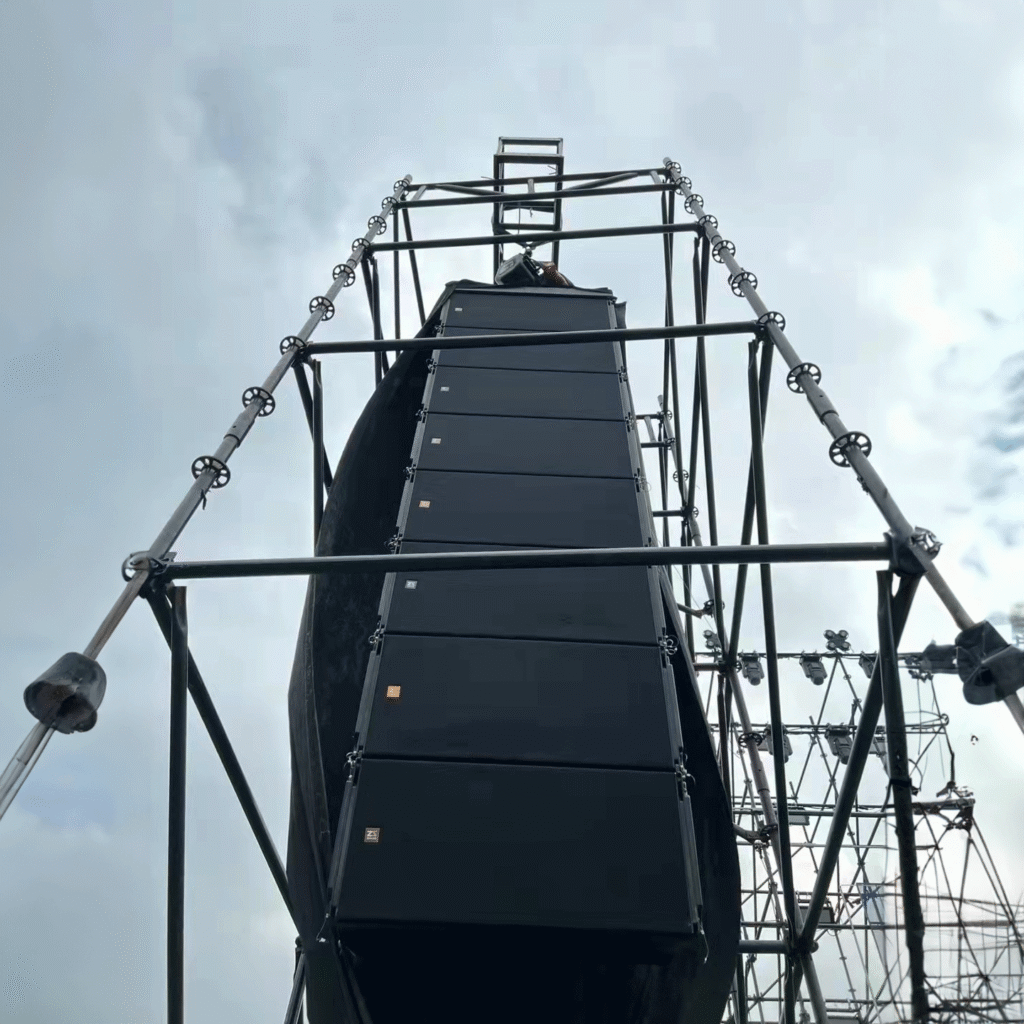
If you have ever been to a large outdoor festival or a stadium concert, you have likely seen tall, curved towers of speakers hanging on either side of the stage. These towers are known as a Professional Line Array System. Unlike the speakers you might have in your living room, these systems are engineered to throw high-quality sound over incredibly long distances, ensuring that whether you are in the front row or the very back, the music sounds crystal clear.
At ZSOUND PRO AUDIO, we specialize in these complex “sound curtains” to provide complete audio solutions for everything from small churches to massive world tours.
Why Do We Need a Line Array?
The main reason professionals use a Professional Line Array System instead of standard “Point Source” speakers (individual speakers placed on stands) is to solve the problem of sound fading. In a standard setup, sound loses energy very quickly as it travels away from the source. This often results in the front of the audience being overwhelmed by volume while the back can barely hear.
A line array uses physics to create a “cylindrical wave” of sound. Because the speaker units (often called “elements”) are stacked vertically, the sound waves interact in a way that allows them to travel much further with less volume loss. This creates “consistent coverage,” meaning the volume stays balanced across the entire venue.
Recursive Explanation: What is a Driver?
Inside each speaker element, like the ZSOUND LC10, there are components called “Drivers”. Think of a driver as the engine of the speaker. It converts electricity into physical movement to create sound.
- LF (Low Frequency) Drivers: These handle the deeper sounds, like bass guitars or male voices.
- HF (High Frequency) Drivers: These handle the high, sharp sounds, like cymbals or high-pitched vocals.
How Does it Achieve Its Unique Effect?
The unique “look” of a Professional Line Array System is not just for style; it is functional. Each element is designed with specific “Nominal Coverage” angles.
For example, the ZSOUND LA110 has a horizontal coverage of 90° and a vertical coverage of 10°.
- Horizontal (90°): This ensures the sound spreads wide enough to cover the whole audience from left to right.
- Vertical (10°): This is the secret. By keeping the sound spread very narrow vertically, we can “aim” the sound precisely at the audience’s ears and avoid bouncing sound off the ceiling or floor, which causes messy echoes.
To make this even more effective, ZSOUND uses Neodymium high-sensitivity drivers in many models like the VCM.
Recursive Explanation: What is Neodymium?
Neodymium is a “rare-earth” metal used to make incredibly powerful magnets. By using neodymium magnets instead of traditional heavy ones, we can make speakers that are much lighter but also much louder. This allows for “Maximum SPL” (Sound Pressure Level, which is the technical way to measure loudness) reaching levels as high as 137 dB or more.
Planning Your Stage: The Brains and the Heart
Designing a stage layout requires more than just hanging speakers. A Professional Line Array System is part of an ecosystem that includes “Subwoofers,” “Amplifiers,” and “Processors”.
Common Setup Ratios
You will often hear ZSOUND engineers talk about the “4+2” or “8+4” setup. This refers to the ratio of line array speakers to Subwoofers.
- Subwoofer: A specialized speaker, like the S28 or LA18S, designed solely to handle ultra-low, “rumbling” sounds that you feel in your chest.
- The “4+2”: This is a popular configuration for small to medium events, featuring four line array elements (like the LA110) paired with two subwoofers per side.
The System Power
Every system needs a “Brain” and a “Heart.”
- The Heart (Amplifier): Models like the MA2400S provide the raw electrical power needed to move the speaker drivers.
- The Brain (Processor): The M44T Digital Signal Processor controls the timing and tone of every speaker, ensuring they all work together as one single unit.
- The Power Hub: Finally, the TCD series Distribution Box safely manages the electricity for the entire rig, protecting your expensive equipment from power surges.
By combining these precision-engineered components, ZSOUND ensures that your Professional Line Array System delivers world-class performance every time you turn it on.