

Understanding Line Array Speaker Basics: A Comprehensive Guide for Beginners
Introduction to Line Array Speaker Basics: Fundamentals and Key Concepts
Introduction to Line Array Speakers
Welcome to the first part of our series on line array speakers. In this article, we will introduce you to the basics of line array speakers, their working principles, and why they are so popular in professional audio applications.
What is a Line Array Speaker?
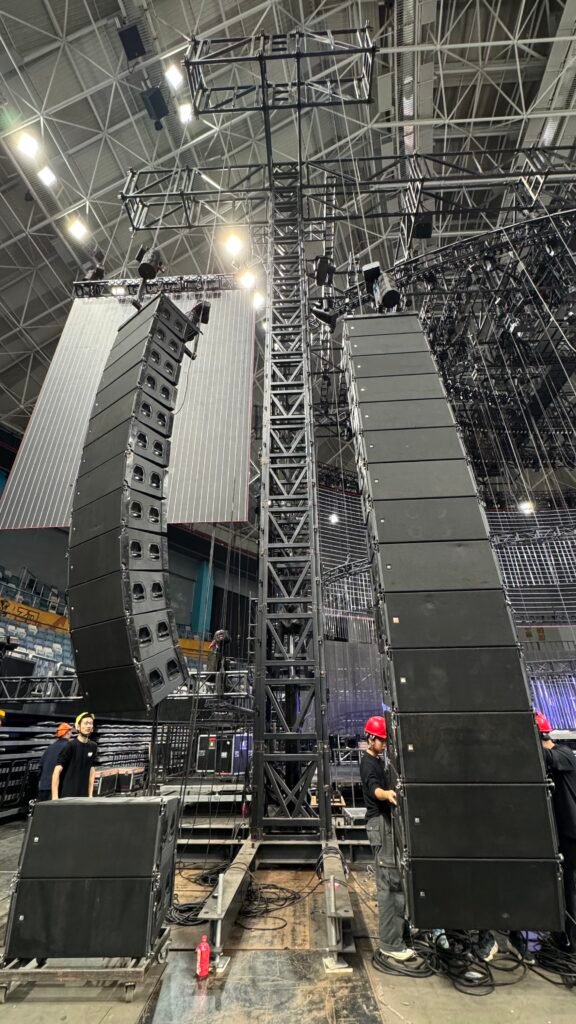
A line array speaker is a type of loudspeaker system that consists of multiple drivers arranged in a linear configuration. The primary purpose of this design is to provide a consistent and even sound coverage over a wide area. Unlike traditional point-source speakers, line array speakers can project sound over long distances with minimal loss in volume and clarity.
Working Principles
Line array speakers work by utilizing the principle of interference. When multiple speakers are aligned in a line, their combined sound waves interfere constructively, creating a more focused and powerful output. This results in a more uniform sound distribution, especially in vertical coverage.
Advantages and Applications
- Consistent Sound Coverage: Line array speakers provide a consistent sound level across a large audience area, ensuring that everyone in the venue hears the same quality of sound.
- High SPL (Sound Pressure Level): These systems are capable of producing high sound pressure levels, making them ideal for large venues such as stadiums, theaters, and outdoor events.
- Versatility: Line array speakers can be used in a variety of settings, from small clubs to large concert halls and outdoor music festivals.
Types of Line Array Speakers
- Passive vs. Active Line Array Speakers:
- Passive Line Array Speakers: These require an external amplifier to power the speakers. They are often more cost-effective and flexible in terms of setup.
- Active Line Array Speakers: These have built-in amplifiers, which simplifies the setup process and often provides better performance due to optimized matching between the amplifier and the speaker.
- Different Configurations:
- 8-inch, 10-inch, 12-inch, and Dual 10-inch Line Array Speakers: Each configuration has its own advantages and is suitable for different applications. For example, the LA110-E1 is a 10-inch line array speaker designed for full-range applications in theaters, multi-function halls, and churches. It features a neodymium high-sensitivity driver, small enclosure, and high SPL to volume ratio. The LC102 is another 10-inch line array speaker known for its compact size, light weight, and high SPL, making it ideal for touring performances, clubs, and multi-function halls.
Key Components and Technologies
- Drivers:
- Low-Frequency (LF) Drivers: These handle the bass and lower midrange frequencies. For example, the LA110-E uses a 10-inch woofer.
- High-Frequency (HF) Drivers: These handle the treble and upper midrange frequencies. The LA110-E also includes a 3-inch compression driver.
- Crossover and DSP Processing:
- Crossover: This component divides the incoming audio signal into separate frequency bands, directing each band to the appropriate driver.
- DSP (Digital Signal Processing): Modern line array speakers often include DSP processing to optimize the sound, providing features such as equalization, limiting, and delay compensation.
- Rigging and Installation Hardware:
- Rigging Systems: These are essential for mounting and aligning the speakers. They are designed to handle the weight and ensure the stability of the line array.
- Adjustable Angles: Many line array speakers, like the LA110-E and LC10, offer adjustable angles to fine-tune the sound coverage.
Choosing the Right Line Array Speaker
- Venue Size and Requirements: Consider the size of the venue and the specific requirements of the application. For example, a smaller venue might benefit from a 10-inch line array speaker, while a larger venue might require a 12-inch or dual 10-inch system.
- Sound Coverage and Frequency Response: Look for speakers with the appropriate nominal coverage and frequency response. The LA110-E offers a frequency response of 60 Hz-18 kHz (±3 dB) and a nominal coverage of 90°(H), 10°(V) adjustable, making it suitable for a wide range of applications.
Leave a Reply